

Trauma has become a buzz word that is spoken quite often on social media, in casual conversations, and many other settings. What is trauma? Does everyone experiencing trauma develop Post Traumatic Stress Disorder (PTSD)? Why does one person experience a traumatic event with little to no long-term effects and others face long-term challenges?
Trauma comes in different forms, physical and psychological. Physical traumas are seen in medical settings and used to describe visible types of injuries or wounds. Psychological traumas can be thought of the same way to describe injuries, but these injuries or wounds are not visible. Trauma in a psychological setting, as described by the American Psychological Association, is an emotional response to a distressing event. These distressing events can include accidents, crimes, natural disasters, abuse (physical and/or emotional), experiencing or witnessing violence, the death of a loved one, and war (APA source). Emotional reactions to distressing events are considered normal. A person may find themselves in shock, experience denial, and emote anger or sadness because of the traumatic event. When the reactions to trauma become abnormal, or challenging, is when a person finds themselves unable to continue with their lives without continued reactions to the traumatic event a few weeks afterwards.
Some symptoms that are more common after experiencing a traumatic event could be difficulty concentrating, trouble sleeping, changes in appetite, loss of interest in usually pleasurable activities, irritability, frequent reoccurring memories of the traumatic event. However, if it’s been more than a month and the memories are still upsetting or causing additional distress in your life, it could mean that a person has Post Traumatic Stress Disorder (PTSD).
PTSD is diagnosed by a trained medical professional using the criteria listed in the DSM IV-TR (Diagnostic and Statistical Manual of Mental Disorders, 5th edition- Text Revision). This manual outlines the criteria that must be met for a person to qualify for a diagnosis of PTSD. These criteria are outlined below for children over 6 years old, adolescents, and adults:

There are stereotypes that exist surrounding PTSD, such as every member of the military has PTSD, or anyone that has seen combat, automatically has a PTSD diagnosis.
However, these are myths and do not represent the military as a whole, or those who do have a diagnosis of PTSD.
Civilians can be diagnosed with PTSD, without any affiliation with the military. It is estimated that 6% of the U.S. population will have PTSD at some point in their lives with roughly 13 million adults in 2020 diagnosed with PTSD (VA source). Women and men are more likely to experience trauma from assault and with women being more likely to be victims of assault, rates of PTSD among women appear to be higher than men. 8% of women vs. 4% of men will have PTSD at some point in their life.
Experiencing trauma may increase a person’s suicide risk. It is difficult to pinpoint the exact reason trauma can increase suicide risk in a person, but suicide is preventable.
Before we dive into Protective Factors, let’s take a moment to hear Scott’s story. Scott Griffith is a veteran and a member of the HOPE military relations team who lives with PTSD. During a suicide prevention panel in 2023, he shared how vital social connection has been in his journey. Click the image below to hear more.
Protective factors not only reduce a person’s likelihood of being diagnosed with PTSD but also reduce the risk for a person to die by suicide.
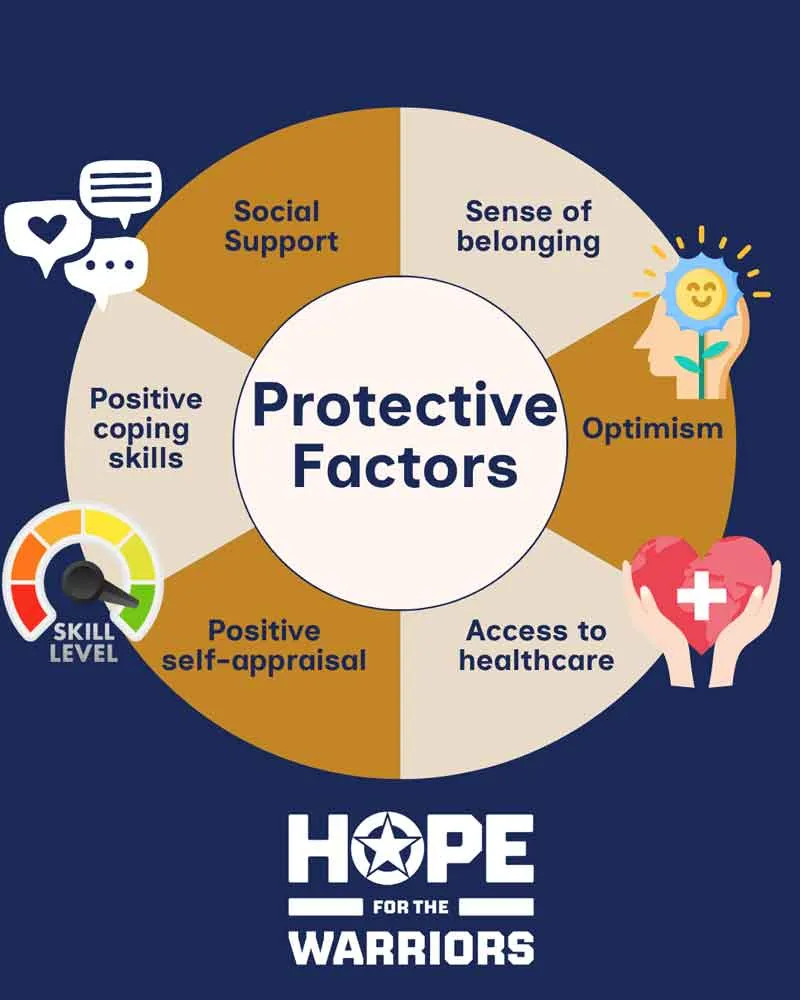
These protective factors can also reduce some of the cooccurring diagnoses that occur with PTSD, such as substance use disorder, depression, and anxiety. Studies related to PTSD and suicide have been inconclusive related to military members and combat service. Some reports show a prolonged exposure to combat, such as multiple combat tours, can increase the severity and chronicity of PTSD, while other reports contradict these findings. Like most mental health challenges, outcomes and treatments vary greatly by person creating difficulty gathering specific data. However, seeking treatment for PTSD shows improved outcomes for a person’s quality of life and contributes to their protective factors against suicide.
A recent study conducted by providers within the VHA shows that veterans beginning therapy with Cognitive Processing Therapy (CPT) or Prolonged Exposure (PE) had a 23% lower risk of suicide compared to those who did not start these therapies. This study greatly improves the importance of trauma specific treatments and their positive impacts on PTSD treatment (Source).
While PTSD can cause significant impairment on a person’s life following a traumatic event, it does not mean a person will carry a PTSD diagnosis with them for life. Recall the specific criteria listed above and the number of elements that must be met for the criteria of a diagnosis of PTSD. Effective treatments for PTSD can reduce or eliminate some of these symptoms allowing for the diagnosis of PTSD to be removed as the person no longer experiences significant distress in different areas of functioning.
Nick Guernsey is a veteran and a Purple Heart recipient who suffers from PTSD. He is open about his past, which included a suicide attempt. Nick shows us that PTSD doesn’t have to be a life sentence.
The most effective treatments for PTSD, from a traditional sense, include talk therapy and medications. Studies have shown that not all talk therapies are created equal when treating PTSD. Therapies focusing on trauma allow an individual to cope with the traumatic event by processing the event and the beliefs surrounding the trauma. Some examples of these trauma focused therapies include Cognitive Processing Therapy (CPT), Eye Movement Desensitization and Reprocessing (EMDR), and Prolonged Exposure (PE). These therapies can be considered short-term and may last 8-16 sessions. Medication management may be necessary to address the physiological symptoms of trauma that prove to be unmanaged with therapy alone. These medications can include specific SNRI and SSRI medications. These medications specifically address serotonin levels in the brain and can work to rebalance the chemical levels and neurotransmitter operations within the brain. The combination of talk therapy with medication management proves to be the most effective for more severe PTSD or chronic PTSD (c-PTSD).
Expressive Arts Therapy
Expressive art therapies—encompassing modalities such as visual arts, music, dance, and writing—offer a transformative pathway for military veterans and families confronting the enduring impact of Post-Traumatic Stress Disorder (PTSD). These creative approaches serve as non-verbal and non-linear alternatives to traditional talk therapy, which can be particularly beneficial for individuals who struggle to articulate deeply embedded trauma.
For members of the Warrior Community, expressive arts foster a safe space for processing memories, reclaiming identity, and re-establishing emotional regulation—critical components in the healing process. When delivered through culturally competent and trauma-informed frameworks, these therapies become a powerful complement to clinical care.
Post-Traumatic Growth
Post-traumatic growth (PTG) refers to the positive psychological changes that can emerge through the struggle with trauma. Rather than a denial of pain, PTG recognizes that adversity can lead to increased personal strength, deeper relationships, a renewed appreciation for life, spiritual development, and new possibilities. While post-traumatic stress may initially disrupt a person’s sense of safety and identity, post-traumatic growth represents the potential for transformation and meaning making in the aftermath. For many veterans and their families, acknowledging both realities is essential to the healing journey.
PTG often results in a deeper sense of purpose, strengthened relationships, and an enhanced appreciation for life. It does not imply that the trauma was beneficial or easy to endure—instead, it acknowledges that through the process of coping and meaning-making, people can cultivate resilience, discover new personal strengths, and reevaluate their priorities. For members of the military community, PTG can manifest in many forms—from renewed commitment to service and advocacy to creative expression and spiritual reflection.
📢 Call for Art: Share Your Story Through Creativity
Hope For The Warriors 2025 Campaign: Post-Traumatic Growth and Suicide Prevention & Awareness
Hope For The Warriors invites members of the Warrior Community: veterans, service members, spouses, caregivers, family members, and children, to submit original works of art for our first-ever virtual art show and digital gallery!
🎨 We Welcome All Forms of Creative Expression:
- Visual Art (paintings, photography, sculpture, digital art)
- Poetry & Spoken Word
- Music (instrumental or vocal)
- Dance & Movement
🧠 Theme: Post-Traumatic Growth, Healing, Resilience & Hope
Your work can reflect personal struggle, remembrance, recovery, or growth. This is more than an exhibit, it’s a platform for empowerment and storytelling.
📅 Submission Deadline: August 1, 2025
📍 Exhibit Launch: September 1, 2025
💬 “This is a chance to illuminate your strength and inspire others.”
Entry Guidelines
- There is no entry fee.
- Submissions must be sent as a jpeg, preferable file size no larger than 15MB
- Save submissions as jpg file as: lastname.firstname.1 (number accordingly – 1, 2, 3, etc.)
- Each submission must include the following information:
- Dimension, Medium, Title and brief description
- Artist Bio (300 character limit)
- Images of accepted works may be used at the sole discretion of Hope For The Warriors® for promotional purposes including but not limited to the invitation, web site or on a subsequent year’s prospectus. Image will include attribution whenever possible.
- 3-5 original works created may be entered.
- All work must be visibly signed by artist (front or back).
- Works will not be priced for sale.
- Work must be original in concept and design and created by the artist.
- Photographic prints must be made directly by the artist, and shall have been analog or digitally processed by the artist.