
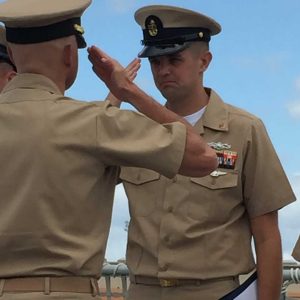
”“I have a ways to go, but I can never go back.”
– Navy Veteran Dustin Gruwell
Drowning in addiction is a nightmare. A relentless freefall into darkness with no end in sight. It’s like being trapped in a deep, suffocating pit, where sunlight teases your skin, but all you taste is the grit of mud and despair. The more you fight, the deeper you sink, your strength fading with every desperate claw at the slick walls. For Navy veteran Dustin Gruwell, that pit became his reality, a place where the only escape seemed to be an irreversible choice of ending his own life. But just as the darkness threatened to consume him, Hope For The Warriors cast him a lifeline—a sturdy rope of support, pulling him back into the warmth of the sun, the crispness of fresh air, and the possibility of a new beginning.
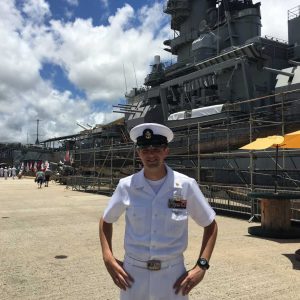 Dustin grew up in a small town in Wyoming, always yearning to be part of something bigger than himself. “I’m from the least populous county in the least populous state,” he says with a chuckle. Charismatic and quick-witted, he’s the kind of person who draws others in effortlessly, sparking conversation with an open, inviting tone and a genuine curiosity about people and their stories. His sharp mind and natural charisma led him to join the Navy in 2006, specializing in Operational Intelligence. His service took him across the globe, with stops in South Korea, Washington, Nebraska, and Cuba over the course of nine and a half years. But beneath the excitement of his career, an invisible toll was building. “I didn’t realize at the time the mental damage I was doing to myself,” he admits.
He got out of the Navy in 2016, but he was never the same. “I have floundered for the last eight and a half years,” he says. It’s unfortunately a common story. Like so many veterans, Dustin battles with PTSD, and that led to addiction and eventually financial hardships. He was walking down the path in the dark – the pit was within a few yards – and the buildup to the Ukraine war triggered painful memories, intensifying his PTSD. The distress became overwhelming, and he just…slipped. “Here I am like bawling on the phone to my mom, drinking just to cover up everything, all the pain, anxiety and depression,” he recalls. “And then, I quit a six-figure a year job, just like that. Boom.”
In search of a fresh start, Dustin tried working at New York Life, but the instability of commission-based work proved too stressful. He returned to a contracting position on base, but old traumas resurfaced, and he relapsed. The cycle continued, pulling him deeper into the pit of depression and addiction.
By mid-2023, Dustin had reached his breaking point. “By June, I was so depressed and consumed by anxiety that I was searching for a way out, any way out. That’s how bad it got.” Suicide was no longer just a passing thought; it felt like the only escape. He was on the verge of becoming another devastating statistic, one of the 17 veterans lost to suicide each day. Trapped in darkness, he couldn’t see a way forward.
A former boss from Iraq recognized the severity of Dustin’s situation and stepped in, bringing him to his home to detox. When Dustin began experiencing stroke-like symptoms, he realized he needed immediate help. He checked himself into the VA hospital, where doctors revealed he had a dangerously high blood alcohol level. “I didn’t even drink that day, and I was four-times over the legal limit.” This was the wake-up call he needed.
Dustin committed to recovery, spending eight weeks in inpatient treatment followed by eight weeks of outpatient care. While his health was improving, his financial situation was deteriorating. He had been on leave without pay, and when he attempted to return to work, he was laid off. With no paycheck since July and bills piling up, he had to act fast.
Dustin turned to his mother for guidance. Her advice was simple: “Start looking for resources.” He was out of rehab and on the path to sobriety, but the financial stress could easily lead to a relapse. Through a Google search, he found Hope For The Warriors. “I read about the organization and thought, ‘I think I might qualify for their help.’ So, I applied.” A couple of days later, he was sitting down with a HOPE’s Director of Intake Services/Regional Social Worker, Kady Luke and one of HOPE’s MSW interns, Cindy Badger. “Providing assistance to veterans in addiction recovery is both a lifeline and a leap of faith. It acknowledges their vulnerability in rebuilding stability while empowering them to reclaim independence and dignity,” Cindy stated. “True healing extends beyond sobriety—it includes the security to move forward with hope and purpose.”
HOPE provided two mortgage payments and a car payment. “It was a weight off my shoulders so I could focus on finding a job. To assist with that portion of Dustin’s journey, Kady connected him with HOPE’s Career Transition Case Manager/Scholarship Program Manager, Kristy Warren. “Kristy provided resume assistance, interview prep, and access to job resources,” Dustin says with a smile. With her help, he aced an interview and secured a new position working with homeless veterans. “Kristy sat with me for two hours, prepping me for interviews. She gave me pointers I hadn’t even thought about. I went through one 20-minute interview and got the job. That’s how prepared I was, thanks to HOPE.”
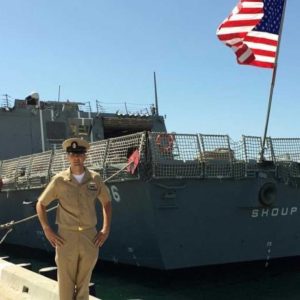 Today, Dustin is focused on his recovery and future. While he acknowledges the long road ahead, he’s determined never to return to where he was. “I’m in full-blood recovery. I’ve got my mental health somewhat under control. I still have a long way to go, but I know I can never go back.” Dustin is aware of his mental health struggles and triggers, so he recognizes that working with homeless veterans might not be the best path for him right now. He’s currently working odd jobs while focusing on his recovery.
Hope For The Warriors remains a steady presence in his journey.
“They don’t just say, ‘Okay, you got a job, see you later.’ They check in, they care. And if everything ever fell apart again, I know they’d be there to help. But that’s never going to happen because I’m only looking up.”
For many veterans like Dustin, the toughest battles aren’t fought on the battlefield, they’re fought in silence, behind closed doors. The weight of invisible wounds can feel like being trapped in a room with no way out. But sometimes, all it takes is the courage to reach for the handle and open the door to help. “Asking for help was the hardest thing I’ve ever done. For years, I hid alone in darkness, drowning my pain in alcohol, convinced that no one would understand. I thought I was the only one, but I wasn’t.” Dustin said. “The truth is, taking that first step is the biggest challenge, but it’s also the most important. Looking back, I wish I had reached out sooner to organizations like Hope For The Warriors. When I finally did, they provided the support I needed to get back on my feet. I’m still on my journey, but now, I know I don’t have to walk it alone.”
Dustin’s story is a powerful reminder that even in the deepest, darkest pits, HOPE is never out of reach. With perseverance, support, and the right resources, the walls that once felt impossible to climb can become steppingstones to solid ground. Veterans like Dustin can rise from the depths, reclaim their lives, and stand in the sunlight once more, uplifted and prepared to face the complexities of civilian life.
Hope For The Warriors values resilience, partnering with military service members, veterans, and families in creating and maintaining a sense of well-being.
If you or a service member you know is struggling to meet their needs, HOPE is here to help. Connect to services today. You are not alone.